

Here is my little collection so far. The large majority of these books were written by Julia Cook. She is my go-to author for books to use with my Social Thinking groups. I would say that her books are best suited for third through fifth grade. I've read her "I'm a booger, treat me with respect" to younger students without too much of a problem, but "A bad case of the tattle tongue" was a bit too much for 1st-2nd grades. Otherwise, her books are excellent resources for addressing specific behaviors.

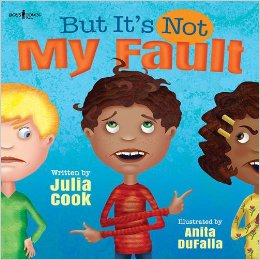
This is one of the books that I've used recently with my inclusion groups. I try to split the books up over two sessions. In the first session, we identify the character's problem and rate the size of the problem. It's pretty similar to what I do when using a video. We brainstorm expected and unexpected solutions for the problem. We review the problem at the start of the second session and see how the character actually resolves his/her problem. Then, I come to my favorite part of the entire lesson: creating an Unthinkable for the character's problem. In the case of this book, R.J. kept saying things that were mean even though he thought he was just saying the truth. My students had to come up with a name for their Unthinkable, a picture, a power, and a way to defeat their new Unthinkable. A few of their creations were "Sassy Susie" who says things that are sassy to adults; "Feedback Phantom" who gives negative feedback; "Feedback Monster" who gives negative feedback; and "The Truth Hurts Man."
Noodle, who we are currently following, happens to be one of my favorite characters from Julia Cook's books. He is someone that my students have really related to and have tried to defend. This, dear readers, is why the brainstorming is so important in my lessons.

Teacher buy-in is also crucial. I am really fortunate that all four teachers have trusted me enough to let me take over their rooms for an hour each week for these lessons. I had to get to another group one day before my students had a chance to share their Unthinkables. The teacher sent me this list of names on Facebook that evening so I could still see their terrific ideas. They've told me about how certain students are using these skills in the cafeteria and on the playground....it's just amazing to know how far they've come as classes.

I'm looking forward to seeing what they will do with our next book as many of them struggle with not wanting to make mistakes. I introduced the topic with Noodle and several of them told me then that they had never seen mistakes as a chance to learn.

What books do you use to teach social skills?
P.S. I purchased the majority of these books on Amazon and a few are from thrift stores.


